
Part of our series on bringing theories to life with experiential learning. Read the rest here.
John Kotter is a Harvard Business School professor most famous for his work on leading organisational change.
His 8-Step Change Model sets out eight stages: create urgency, build a guiding coalition, form a strategic vision, enlist a volunteer army, enable action by removing barriers, generate short-term wins, sustain acceleration and institute change.
This framework remains popular with leaders and facilitators looking to drive change that lasts. In this blog post we’ll explore the model in more detail, and share a change management workshop that uses experiential learning activities to bring each of Kotter’s steps to life.
Here’s what we’ll cover:
What is Kotter’s 8-Step change model
The 8 steps of Kotter’s change model
A worked example of the model in practice [TBC]
Kotter’s 8-Step change model in healthcare [TBC
Criticism and limitations
Bringing Kotter’s 8-Step Model to life with experiential learning
Sample Session Flow for Change Management Workshops
FAQs
What is Kotter’s 8-Step Change Model?
Kotter’s 8-Step Change Model is a framework for leading organisational change. The model was developed by Harvard Business School professor John Kotter, and sets out eight steps spanning building initial momentum through to embedding the change in an organisation.
Kotter first set out his ideas in a 1995 Harvard Business Review article, introduced the model formally in his 1996 book called Leading Change, and revisited it in a 2014 book called Accelerate.
Here is a summary of this evolution:
In the 1995 article Kotter drew on over 100 companies where he’d watched attempts at change fail, allowing him to identify 8 common errors that caused them all to stall. The 8 steps were conceived to address each of these errors.
In Leading Change Kotter expanded the article into a full framework, with a chapter for each step. This book sets out the sequence still commonly understood as the 8-step model - the steps run in order and each builds conditions for the next.
In Accelerate Kotter reframed the steps as accelerators that run continuously and in parallel, rather than in sequence. He also shifted more emphasis towards sustained urgency and a volunteer army, rather than a small group pushing for change.
Kotter’s main findings have been held since 1995. They also chime with what we’ve seen over the years when facilitating change management: the reason that change efforts often fail are usually human or organisational, rather than technical.
The 8 Steps of Kotter’s Change Model
Each of the eight steps is designed to counter the failure points that regularly disrupt change management. The eight steps in order, as currently presented by Kotter, are:
Create a sense of urgency: make the case for why change matters now
Build a guiding coalition: a core team with the influence to lead change
Form a strategic vision: clearly define where you’re going and how
Enlist a volunteer army: the goal is broad buy-in to the vision rather than just compliance
Enable action by removing barriers: identify and clear the barriers in the way of change
Generate short-term wins: create visible proof that real progress is happening
Sustain acceleration: keep things moving rather than declaring victory too early
Institute change: ensure the new ways of working are anchored and will last
Below we explore each step in more detail and place them in context.
Step 1: Create a sense of urgency
The goal: help people feel that change is necessary, and that it can’t wait. This urgency should lead to conviction rather than panic.
Why it matters: without urgency change competes (and usually loses against) the inertia of ‘business as usual’
In practice: sharing the evidence honestly increases its impact and helps to make the risk of standing still tangible
Common pitfall: creating false urgency - activity and anxiety that look like urgency but aren’t linked to a real opportunity. Do this and energy burns out fast
Diagnostic question: Does the team actually feel this is urgent, or have they just been told it is?
Step 2: Build a guiding coalition
The goal: bring together a group with enough authority, credibility and diversity of perspective to drive the change
Why it matters: single leaders can rarely if ever carry major change alone - it needs to be led by a coalition that others trust and follow
In practice: consider influence and credibility rather than just seniority. Include people who can unblock decisions and who others actually listen to
Common pitfall: building a coalition that’s just the boss and a few direct reports
Diagnostic question: If the person leading the change left tomorrow, would it have enough backing to survive?
Step 3: Form a strategic vision and initiatives
The goal: to create a clear, compelling picture of the future and the route to get there
Why it matters: a unifying vision makes thousands of individual decisions easier because people can see where they’re heading
In practice: keep it short enough to explain in a minute, and pair with a handful of clearly understandable initiatives
Common pitfall: landing on a vague slogan or a 40-page plan instead of a vision
Diagnostic question: Can everyone in the room describe the destination in a sentence? Do the descriptions match?
Step 4: Enlist a volunteer army
The goal: communicate the vision widely and well enough that people choose to get behind it
Why it matters: scaling needs willing participation because mandated change rarely reaches the required depth
In practice: repeat the message through many channels and lead by example
Common pitfall: under-communicating or undercutting the message with behaviour that contradicts it.
Diagnostic question: Are leaders modelling the change, or just announcing it?
Step 5: Enable action by removing barriers
The goal: Identify and clear the obstacles (structures, processes, skills gaps) that stop people acting on the vision.
Why it matters: motivated people who keep encountering barriers are likely to become cynical - removing potential friction turns buy-in into action
In practice: ask the people doing the work what’s getting in their way, then take steps to actually fix it
Common pitfall: rallying people to act then leaving the existing barriers to action in place
Diagnostic question: What’s the single biggest thing stopping people acting on this today and who is responsible for removing it?
Step 6: Generate short-term wins
The goal: to plan for and deliver visible successes early in the process
Why it matters: small quick wins prove the change is working, and rewarding them strengthens the underlying case for change
In practice: choose targets that are achievable, meaningful and visible early on, and make a point of recognising them
Common pitfall: no visible, tangible wins are acknowledged within 6–18 months
Diagnostic question: What win can we point to within the next three months, and how will people hear about it?
Step 7: Sustain acceleration
The goal: to build on the credibility from early wins rather than easing off
Why it matters: this is the stage where many efforts die: early success being mistaken for the finish line risks leaving the hardest changes undone
In practice: keep urgency up, continue to remove barriers, and begin tackling the more entrenched problems
Common pitfall: declaring victory too soon is the single failure that Kotter is most associated with warning against
Diagnostic question: Are we consolidating because the work is done, or because it’s getting hard?
Step 8: Institute change
The goal: to embed the new approaches into the organisation’s culture so they outlast the people who led them
Why it matters: until change is reflected in organisational norms, habits and processes, it’s at higher risk of slipping
In practice: clearly state the link between the new behaviours and better results, build them into recruitment, onboarding and promotion, and tell the story of why they matter
Common pitfall: treating go-live as the end allowing new behaviours to revert to old ones
Diagnostic question: If we stopped actively managing this change tomorrow, would it stick or slide back?
Criticisms and Limitations of Kotter’s 8-Step Model
Despite its popularity and endurance, there are criticisms of the theory. Facilitating change management effectively relies on understanding where the model falls short. Common critiques are:
Top-down, leader-led: it assumes change is driven from the top with everyone enlisted to bring someone else’s vision to fruition. This underplays grassroots change and the value of participation from people affected by the change in the process.
Linearity can be rigid: an 8-step model invites assumptions that things will progress neatly from one step to the next until the change is locked in, but in reality things loop back, steps run in parallel, and so on.
The evidence is thin: the model is built on Kotter’s observations with the model as a whole not being hugely substantiated by research, despite agreement that the individual steps do tend to hold up
Experiential Learning Activities to Bring Kotter’s 8-Step Model to Life
Kotter’s model names the steps required to achieve change, but reading and being familiar with the theory isn’t enough. To effectively lead or participate meaningfully in change, people need experience practicing the skills required, reflecting on their outcome, and repeating the process.
In this section we recommend two experiential learning activities that will help you to teach Kotter’s model through experience. They weren’t designed specifically for the 8-Step Model, but map naturally onto its steps and are effective in helping participants understand and internalise what leading change actually needs.
Taller Stack - from MTa Insights
This is an accessible introductory activity to the experience of imposed change, and leading through others. Teams are asked to build a freestanding stack against the clock, then the structure changes and group membership is shuffled without warning.
Best for: experiencing the human side of Kotter’s early steps (creating urgency, building a guiding coalition, enlisting a volunteer army, and enabling action by removing barriers.
When to use: early in a change programme. This activity is great for surfacing honest reactions to imposed change, before a group moves on to tackling deeper work.
Pain points addressed: resistance to imposed change, leaders defaulting to hands-on control, weak commitment from teams with little to no input in the plan
Why it works: this recreates what staff feel during a restructure, what leaders inherit when they take on change. Restrictions on touching components mean that leaders have to empower others, clearly showcasing what leading change rather than doing it feels like
Example coaching question: when the reorganisation was announced and you were moved, what did you feel? Did that impact how willing you were to get behind the new leader?
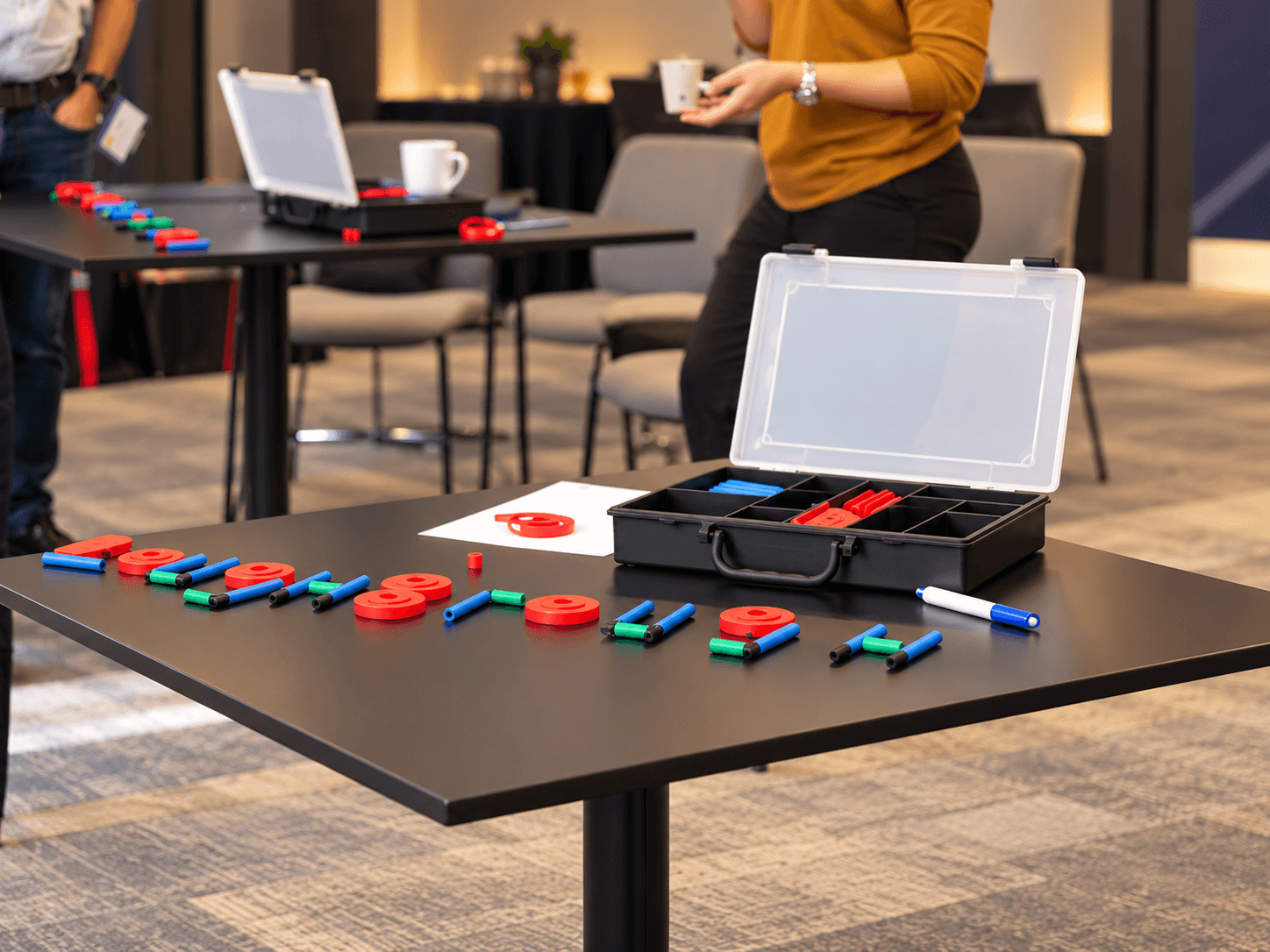
Words, Names and Numbers - from MTa MINI
Three teams each work on perfecting a separate task: a word, a name, a set of numbers. Then they’re reorganised into a single team with a shared brief that looks daunting, but is actually just a combination of the original tasks with some added constraints. There’s an easy route forward but success requires something different.
Best for: forming a shared strategic vision, enabling action by removing barriers, sustained acceleration and instituting change
When to use: later in a program, or with a group who are ready to explore the attitudes that make or break change
Pain points addressed: challenging “this is how we’ve always done it” thinking, mistaking perceived constraints for real ones, change slipping once a reorganisation is “done”
Why it works: participants feel reluctant to let go, and many of the constraints are perceived rather than real - meaning progress depends on telling the difference. This mirrors the tendency fo emerged teams to default to old approaches rather than using the change to explore new ones
Example coaching question: at what point did you decide to build on our original work rather than start fresh, and what did that choice cost you once you understood the new requirements?
Need help choosing change management activities?
Book a 1-on-1 chat with a member of the MTa team
Sample Session Flow for Change Management Workshops
While there's no one-size-fits-all change-leadership session, the two flows below provide examples for facilitators who want to teach the model experientially.
Option 1: Introduction to Leading Change (half-day)
Facilitation goal: to help participants understand the model and experience both sides of change through experiential learning:
Welcome + intro to Kotter's 8-Step Model (15 mins)
Experiential activity: Taller Stack (45 mins including debrief)
Break + reflection (15 mins)
Experiential activity: Words, Names and Numbers (90 mins including debrief)
Recap: mapping moments to Kotter's steps (20 mins)
Discussion: applying the model to change at work (20 mins)
Option 2: Focused Skill Development (90–120 mins)
Facilitation goal: to deepen one aspect of leading change (generating buy-in or capitalising on change) through a targeted activity.
Welcome + intro (10 mins)
Experiential activity: Taller Stack or Words, Names and Numbers (30–120 mins depending on choice)
Small group review (20 mins)
Discussion: how this relates to our work (15 mins)
Wrap-up and next steps (10 mins)
How to Effectively Review Change Management Training Sessions
Facilitated reflection is where deep learning happens. Our recommended activities will surface reactions and challenge assumptions, but the structured review phase connects those moments to the model, and to participants' own change challenges at work.
A good review process should do three things:
Surface what happened: encourage participants to describe how the activity unfolded, focussing on the decisions, the behaviours and the reactions to change
Interpret the experience: help the group to explore how the activity mirrored real-world change, and what their responses reveal about how they react to, and lead, it
Apply the learning: prompt participants to connect the insights to a live or upcoming change in their own role
Review Questions to Help Participants Internalise Kotter's 8-Step Model
How was a sense of urgency created (or not created) and how did that impact what followed?
What happened when leadership was imposed or changed? How did people respond, and why?
Which barriers were real, and which were assumed? How did the group treat each?
Where did the group default to "how we've always done it", and what did it cost?
How did short-term wins or their absence impact momentum and morale?
At what point, if any, did the change feel like it had "stuck"? What would have made it stick?
What would you do differently to lead this change more effectively?
How would you explain the step you found hardest to someone who hadn't experienced it?
Facilitating Kotter’s Change Model with Confidence
Kotter’s 8-Step Change Model is a proven roadmap for leading change. By helping people to put the model into practice under real pressure, you can help them build the understanding and confidence they need to participate in or lead change in their organisation.
As a facilitator it’s your job to build that capability, and we’ve designed our experiential learning activities to make your job easier and your training more impactful. Whether you’re introducing the full model or focussing on a specific challenge, our activities let participants live the learning and carry it forward into their organisation.
Next steps:
Explore MTa Insights and the MTa MINI, where the recommended activities can be found
Explore our change management resource
Get in touch for tailored advice on how to achieve your goals
Read our other posts on facilitating training sessions for other models and frameworks